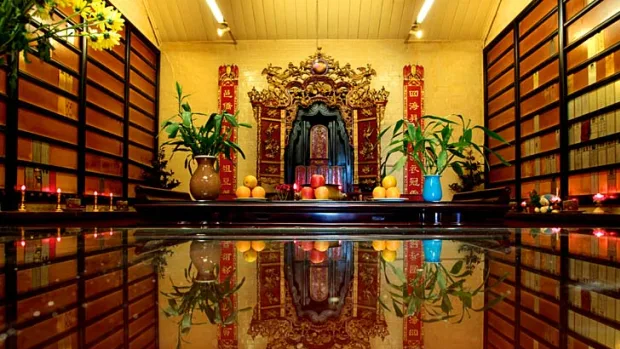
Tucked away in the quiet backstreets of Glebe, the Sze Yup Kwan Ti Temple is more than just a heritage-listed site; it is a resilient spiritual oasis for Sydney’s Chinese community. Having survived over a century of urban change and major fires, the temple stands today as a powerful symbol of loyalty, righteousness, and community bond.
1. The Legend of the “Guiding Light” and Feng Shui Mastery
The temple’s origin is steeped in mystical local legends that have been passed down through generations:
- A Divine Sign: In the late 1890s, settlers from the Sze Yup region of Guangdong were searching for a site to build a place of worship. Legend has it they witnessed a mysterious beam of light shining down upon a market garden on Francis Street (now Edward Street). Believing it was a sign from Kwan Ti (the God of War and Righteousness), they raised £325—a fortune at the time—to purchase the land.
- Feng Shui Excellence: The temple was built following strict Feng Shui principles. It sits on a gentle slope overlooking the waters of Rozelle Bay. This “mountain-backed, water-facing” position is believed to gather Qi (energy), bringing prosperity and protection to the diaspora.
- The Guardian Deity: Unlike many Buddhist temples, this sanctuary honors Kwan Ti. For early migrants facing social injustice and the hardships of the “White Australia Policy,” Kwan Ti represented the ultimate judge and protector—a symbol of courage and integrity to guide them through adversity.
2. Historical Roots: From Glebe’s Market Gardens to a Community Hub
The history of this temple is a testament to the survival of the Chinese community in Sydney:
- A Shelter for Gardeners: In the late 19th century, Glebe was the heart of Chinese-run market gardens. The temple served as a social welfare hub, providing temporary housing for new arrivals and food for the needy.
- “Falling Leaves Return to Their Roots”: A poignant historical detail is that the temple once served as a temporary resting place for the remains of deceased migrants. Their bones were kept in ceramic jars in the temple grounds, awaiting a ship to take them back to China for a traditional burial in their ancestral soil.
- Resilience Through Fire: The temple suffered devastating fires in 1953 and 2009. However, the unwavering support of the community—including the later wave of Chinese-Vietnamese immigrants—ensured the temple was restored to a splendor that surpassed its original state.
3. An Authentic Architectural Experience
Stepping through the gate guarded by stone lions, you enter a space that feels worlds away from modern Sydney:
- The Main Hall: This hall houses the imposing statue of Kwan Ti, surrounded by traditional weapons (the Green Dragon Crescent Blade) and his legendary horse, Red Hare.
- The Side Wings: The East Wing is dedicated to the Hall of Ancestors, while the West Wing honors the God of Wealth (Choi Buk Sing), where devotees pray for prosperity.
- 1898 Treasures: The two intricately carved dragon stone pillars in the main hall are original artifacts from the temple’s founding, standing as priceless relics of early Chinese-Australian history.
4. How to Get There (2026 Transport Update)
The temple is located at 2 Edward St, Glebe NSW 2037. It is easily accessible via public transport:
| Mode of Transport | Routes / Instructions |
| Bus | Take Bus 431 or 433 from Central Station or Town Hall. Get off at Glebe Point Rd near Pendrill St, then walk for 3 minutes. |
| Light Rail | Take the L1 Dulwich Hill Line. Exit at Jubilee Park or Glebe Station. It is a scenic 10-12 minute walk through Glebe’s historic streets. |
| Walking | Approximately a 20-minute walk from Broadway Sydney Shopping Centre. |
Visitor Note: The temple is open daily from 9:00 AM to 4:00 PM. Visitors are asked to dress modestly and maintain a quiet atmosphere. Fortune-telling sticks (Joss sticks) are available, with English translations provided for the divinations.